NewsAI-prepared · review pendingRoboticsNew
Dream Labs announces $90 million seed round and a robot-control API
Dream Labs launched its Dream API alongside funding from B Capital, Kindred and others; broad claims about unfamiliar robots remain unverified here.
Evidence: 2 sources · 1 official record · 1 independent report · 2 open questions
AI-prepared draft. Human editorial review is pending. This story does not claim human verification.

What happened
- Dream Labs and investor Kindred announced the funding and API launch on 19 October.
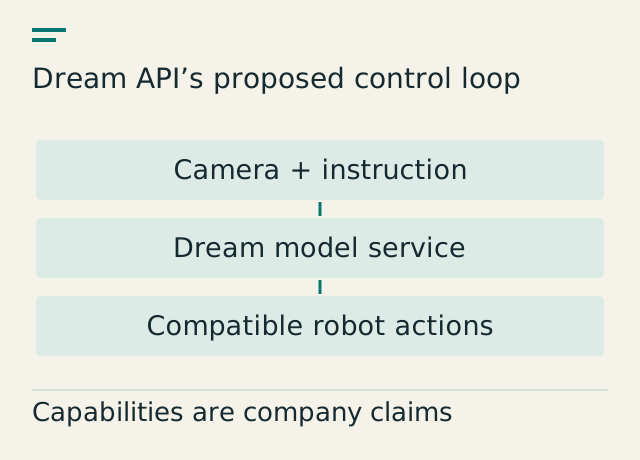
- The product targets two-arm robots with parallel grippers, using camera feeds and language instructions.
Why it matters
A shared control model could reduce integration work, but generalisation must be tested on the actual robot and task.
What is confirmed and what is claimed
Supported by listed sources
Claimed, not independently verified
- Dream Labs says Dream-1 can operate unfamiliar compatible robots and transfer skills between settings. 1
The launch packages robot intelligence as a developer service. SiliconANGLE describes visual input and natural-language commands being translated into actions for compatible hardware.
The important boundary is between a financing-and-product announcement and a demonstrated capability. A developer still needs to test success, recovery from errors, latency and safe stopping in the intended environment.
What we don’t know yet
- Independent task-success rates, failure modes and safety results across customer robots are not established here.
- An API launch does not prove general-purpose autonomy or remove hardware integration requirements.
Evidence and sources
- Primary announcement Kindred investment and Dream API announcement
- Independent reporting Dream Labs raises funding and launches robot API