NewsAI-prepared · review pendingRoboticsNew
Rendezvous raises $20 million for autonomous spacecraft assembly plans
Rendezvous Robotics announced a $20 million seed round for modular spacecraft, with a free-space assembly demonstration planned no earlier than April 2028; the planned mission is not an achieved result.
Evidence: 2 sources · 1 official record · 1 independent report · 2 open questions
AI-prepared draft. Human editorial review is pending. This story does not claim human verification.
What happened
- Rendezvous announced $20 million in seed financing on October 28.
- MaC Venture Capital and Toyota Ventures led the financing.
Why it matters
Autonomous assembly could loosen launch-size constraints, but a funding round and earlier microgravity experiments do not demonstrate a deployable satellite architecture.
What is confirmed and what is claimed
Supported by listed sources
Rendezvous Robotics announced a $20 million seed financing on October 28 to develop spacecraft designed to assemble and reconfigure themselves in orbit. MaC Venture Capital and Toyota Ventures led the round. The immediate development is financing for an autonomous spacecraft programme, not a successful demonstration of its proposed free-flying system.
The company announcement describes independent modules that would maneuver, align and connect after launch. Payload's independent report corroborates the funding and says the in-space demonstration is planned no earlier than April 2028. That timing is a target, rather than an assurance that a spacecraft will be ready then.
Assembly becomes part of the spacecraft
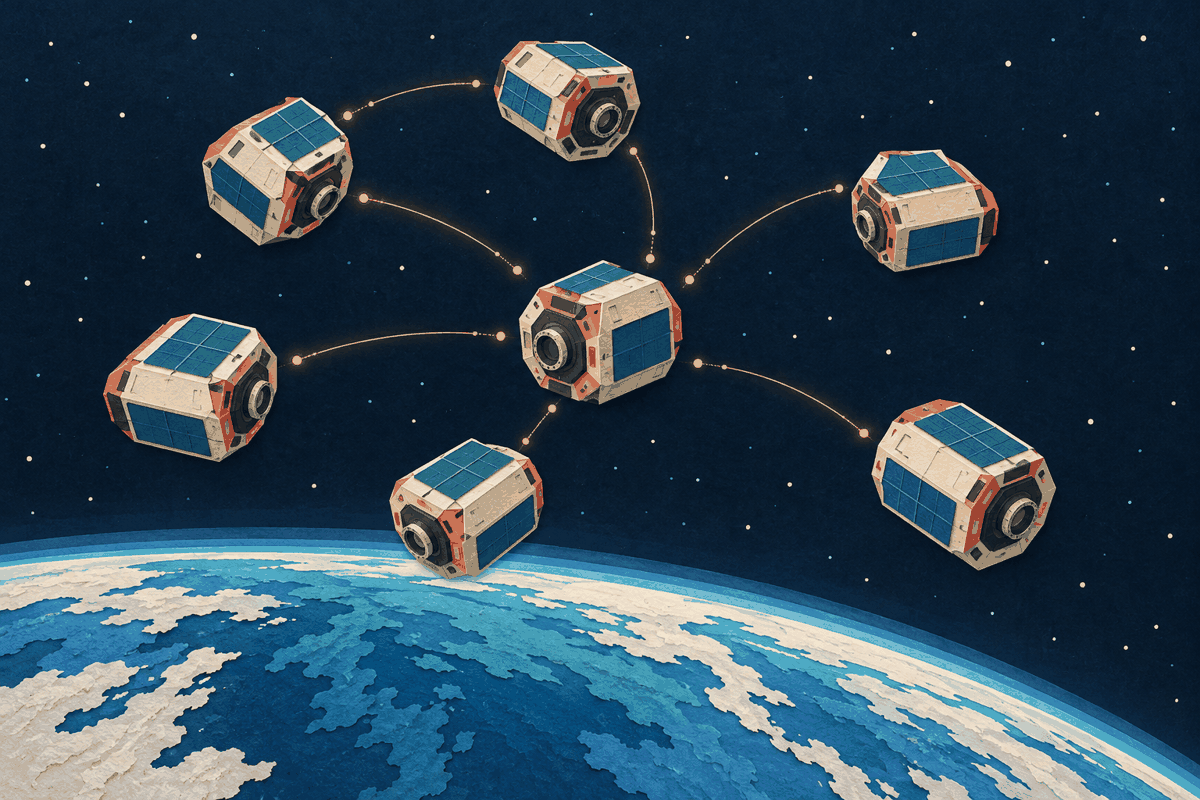
The proposed design replaces a spacecraft built entirely into its final configuration before launch with modules that can be joined later. Rendezvous says seven tiles will form a spacecraft, separate and then assemble into another configuration during the planned demonstration. Autonomous movement and connection are central to that architecture; the checked sources do not establish a specific generative-AI model controlling it.
This is relevant to physical autonomy because the system must coordinate actions involving real objects, alignment and changing configurations. A successful future demonstration would need to establish that these operations work in the intended environment. The financing announcement does not by itself answer that engineering question.
Earlier experiments are a separate milestone
The work builds on TESSERAE research associated with Ariel Ekblaw. Both sources describe previous microgravity experiments, including International Space Station work. The company separately describes a December 2026 ISS experiment involving 32 tiles in a controlled environment. That should not be conflated with seven larger, independently operating tiles joining in free space in 2028.
Rendezvous says the proceeds will support spacecraft development, flight demonstrations and team expansion. Those are plans attributed to the company. Larger structures and later replacement or reconfiguration could offer operators more flexibility, but the checked material does not establish commercial costs, mission-wide reliability or a repeatable servicing business.
The next evidence to watch is demonstrated autonomous assembly under the proposed mission conditions, followed by clear performance and failure data. Until then, the round funds a promising architecture whose operational benefits remain to be tested.
What we don’t know yet
- Whether the free-space demonstration will meet its planned schedule and performance goals.
- Reliability and economics of assembly and reconfiguration in operational missions.
Evidence and sources
- Primary announcement Rendezvous Robotics Raises $20 Million to Build Spacecraft That Assemble Themselves in Orbit
- Independent reporting Exclusive: Rendezvous Robotics Raises $20M to Develop Self-Assembling Spacecraft