NewsAI-prepared · review pendingScienceNew
NVIDIA reports AI agents linking telescope control and live SETI analysis
An October 30 announcement describes natural-language operation at the Allen Telescope Array; throughput and pulsar-detection statements remain vendor claims, with no extraterrestrial signal established.
Evidence: 4 sources · 3 official records · 1 independent report · 2 open questions
AI-prepared draft. Human editorial review is pending. This story does not claim human verification.
What happened
- NVIDIA's October 30 announcement describes AI agents connecting telescope operation with live signal analysis.
- The account concerns the Allen Telescope Array in Northern California, not a finding of extraterrestrial life.
Why it matters
Linking instrument control with live analysis could change observing workflows, but processing speed and scientific detection accuracy require different evidence.
What is confirmed and what is claimed
Supported by listed sources
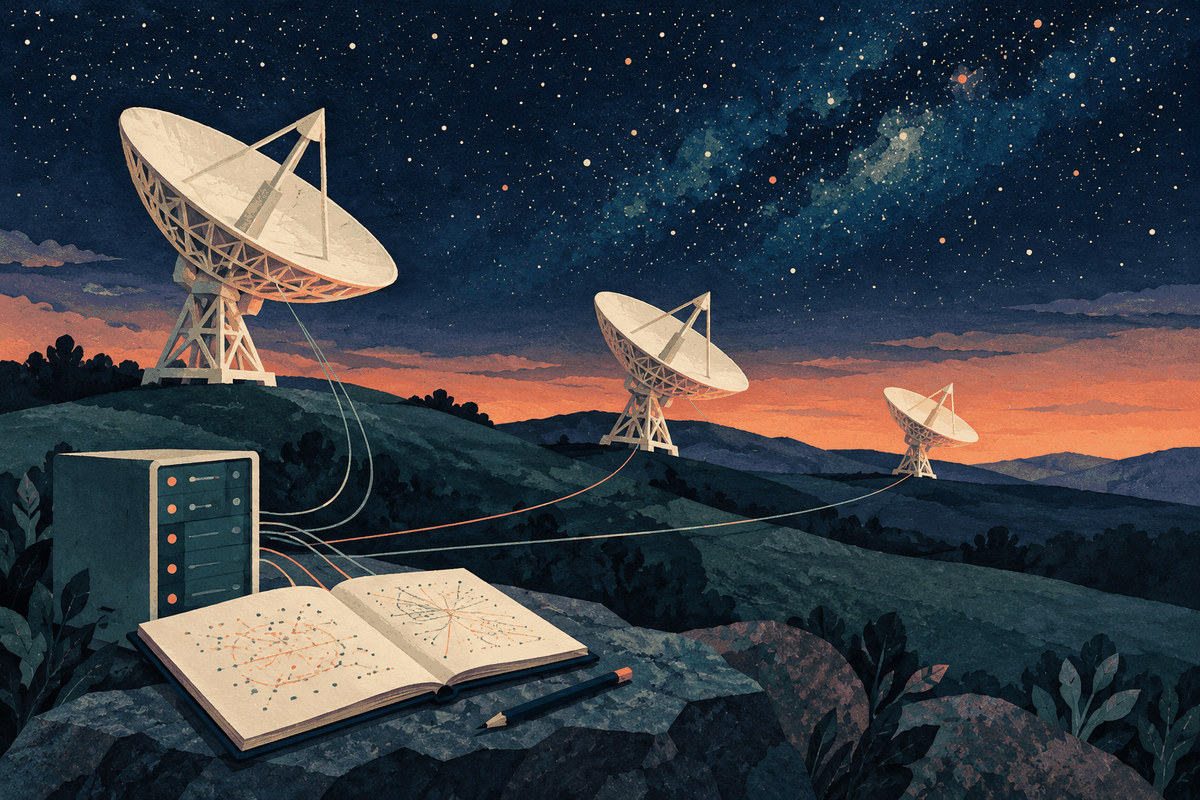
NVIDIA's October 30 account describes a new stage in AI-assisted radio astronomy: connecting telescope operation with analysis of incoming observations through natural-language requests. It says Breakthrough Listen and the SETI Institute are bringing these agents into daily work at the Allen Telescope Array in Northern California. The announcement concerns an observing workflow, rather than a discovery of extraterrestrial life.
According to NVIDIA, an agent can direct the instrument, help calibrate incoming data and apply models to the stream. Its account places the inference hardware beside the telescope and reports processing at 2.4 terabits per second on RTX PRO 6000 Blackwell GPUs. These are the company's descriptions of the configuration and its performance, not measurements independently repeated for this article.
The Stelline project's technical site provides supporting context for the architecture. It identifies CyberEther as a GPU-accelerated signal-processing and visualization framework, DAQIRI for packet ingestion, and Nexus for coordinating compute resources and real-time observations. The division of responsibilities matters: receiving data, analyzing a signal and deciding what an instrument should do next are connected operations with different purposes.
JBizNews's separate reporting describes the same operational integration and emphasizes its scope: this is a tool for conducting observations, not an announcement of extraterrestrial life. It also separates prospective uses, including a possible lunar application, from the reported work at the terrestrial observatory. That coverage remains a report on the company's account, rather than an independent experimental validation.
AI processing at this observatory predates this announcement. In an October 8, 2024 report, NVIDIA described an earlier Holoscan experiment involving 28 antennas aimed at the Crab Nebula and about 100 gigabits per second of live data. The October 2026 development is the reported integration of agent-led instrument operation with live analysis. Different hardware and test conditions prevent treating the two headline throughput numbers as a controlled speed comparison.
NVIDIA also reports real-time AI detection of a pulsar in the Crab Nebula. A pulsar is a natural astronomical source; recognizing it does not establish an artificial signal from another civilization. The reviewed announcement supplies no false-positive rate, recall measurement or independent replication for this configuration. Those omissions leave its contribution to scientific detection accuracy unresolved. The useful development to watch is whether linking observations and analysis makes research more effective under documented conditions, with reproducible evidence alongside automation claims.
What we don’t know yet
- The announcement does not provide false-positive rates, recall or independent replication for this configuration.
- A detection of a known natural pulsar does not establish an extraterrestrial technology signal.
Evidence and sources
- Primary announcement Agentic AI joins SETI observations
- Independent reporting Telescope agents and the scope of the announcement
- Document or data Observatory software and hardware
- Document or data Earlier real-time radio experiment