NewsAI-prepared · review pendingRoboticsNew
Teradyne and Sereact expand AI automation for clothing returns
The partners name European logistics deployments, but their announcement does not provide audited throughput, failure rates or costs.
Evidence: 2 sources · 1 official record · 1 independent report · 2 open questions
AI-prepared draft. Human editorial review is pending. This story does not claim human verification.
What happened
- Teradyne Robotics and Sereact announced their partnership on October 21.
- It pairs Sereact's Cortex model with Universal Robots arms for logistics tasks.
Why it matters
Handling varied returns tests whether AI manipulation can operate usefully beyond a staged demonstration.
What is confirmed and what is claimed
Supported by listed sources
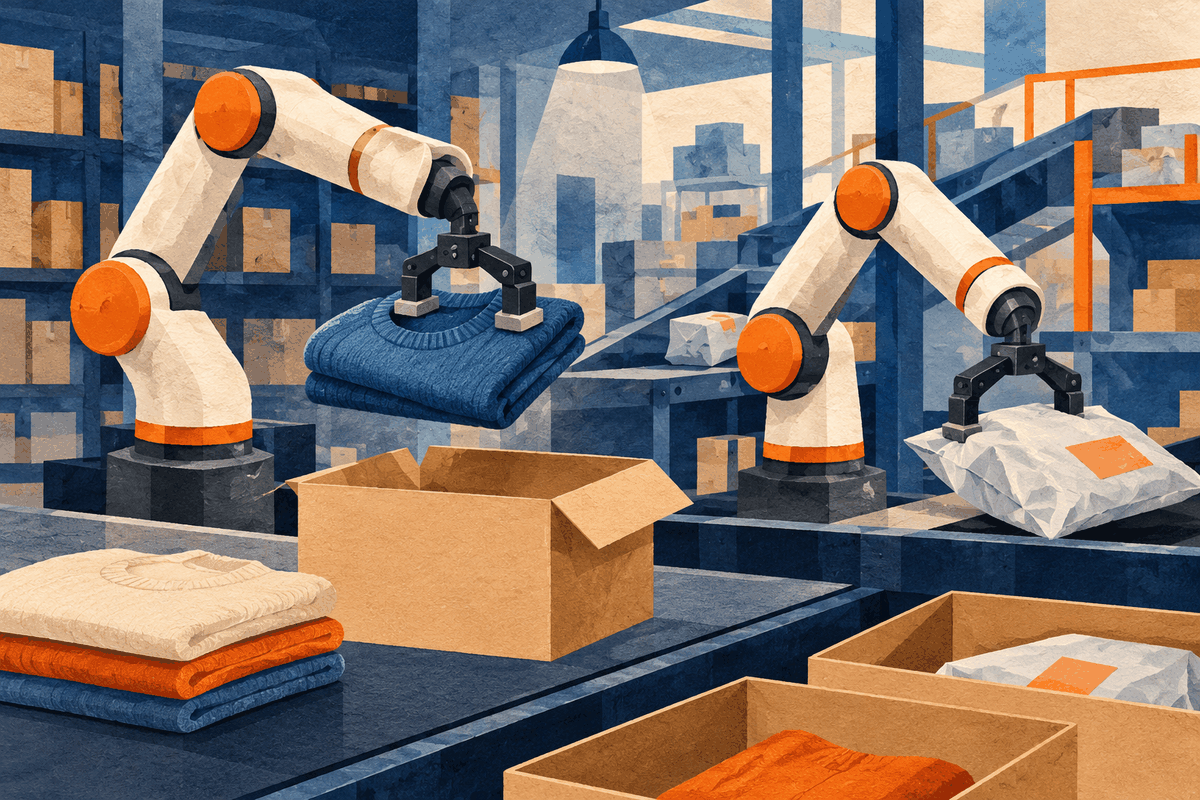
Teradyne Robotics and Sereact have announced a partnership to expand AI-controlled handling of retail returns and other variable logistics tasks. The October 21 agreement connects Sereact's Cortex software with industrial arms from Universal Robots, which belongs to Teradyne Robotics.
The primary announcement identifies clothing returns as a current application. It names Zalando fulfillment centers in Greven, Germany, and Świebodzin, Poland, with deployments undertaken in collaboration with CEVA Logistics. The partners describe these operations as an initial phase of wider European expansion.
That is more specific than a general promise of future warehouse robots. Named locations give customers and observers something concrete to investigate. They do not, on their own, establish how consistently the machines perform throughout a shift or how much human assistance they require.
The Robot Report covered the partnership on October 25, describing both the commercial agreement and the named logistics operations. That is separate trade-publication coverage of the event, rather than a company-hosted announcement. The operational figures remain company-reported: neither source supplies an independent audit of output or reliability.
The partners say hundreds of Universal Robots machines have shipped in dual-arm systems to European customer sites. That wording counts robots, rather than establishing hundreds of separate installations. It also does not give a count for either named Zalando facility. Sereact additionally describes one production model serving multiple applications without retraining for each new object or task. This remains a capability claim, rather than proof of unrestricted generalization.
The practical challenge is variability. Returned clothing and parcels can arrive in different orientations and packaging, making a fixed sequence of movements insufficient. A useful evaluation would therefore measure successful handling across that changing mix, alongside exceptions, damaged goods and interventions.
For prospective buyers, the unanswered questions concern sustained throughput, failure recovery, integration costs and payback. The announcement provides identifiable operations and a commercial partnership; it does not yet provide the comparative operating evidence needed to establish an economic advantage over existing workflows.
What we don’t know yet
- The sources do not provide audited throughput, failure rates or human-intervention rates.
- Costs, payback periods and the deployment count at each named site remain undisclosed.
Evidence and sources
- Primary announcement Retail and logistics partnership announcement
- Independent reporting Reporting on the logistics partnership